
Last week a client came to us with 10,000 SKUs and a problem.
He needed to figure out which ones to cut — by revenue, by gross profit, by vendor — across a catalog that was essentially unmanageable.
My analyst used Claude for Excel. Done in an hour.
This kind of project that would have taken my analyst 15 to 20 hours 6 months ago. And even then, it wouldn’t have been as thorough as what he actually needed.
And he didn’t just get lucky with a great prompt.
He’s a financial analyst who knew what questions to ask, how to pressure test the output, and what the client needed to see. The tool made him 10x better. We delivered it and the client was thrilled.
We’re currently charging that client a flat fee $6,000 a month (including other services).
Whether the analysis takes 50 hours or one, the invoice doesn’t change. Right now, I’m capturing most of that efficiency gain.
But the paranoid founder in me has been thinking more about what this means for the future. And what it means for how all of us should think about finance work going forward.
My perspective: AI is compressing the work, and founders are benefitting from more wisdom.
Value will continue to accrue to both founders and firms like ours. And the total pie will likely expand.
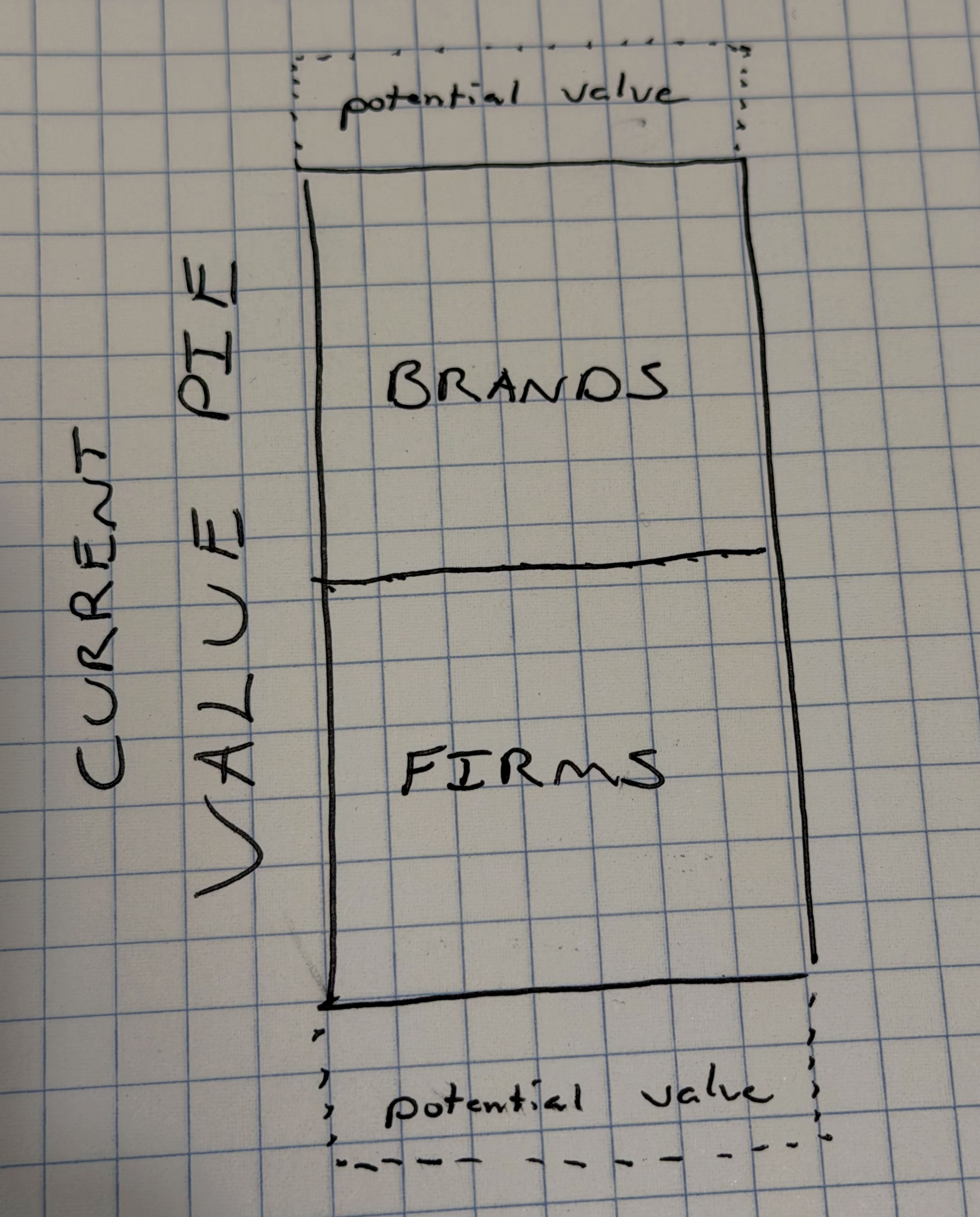
not made by Claude but by my own left hand
Finance work in 4 distinct layers
Inputs —> Analysis —> Judgement —> Orchestration
You’re sitting down to review your monthly financial report with your CFO.
Everything that went into producing that report (the bookkeeping, the reconciliation, the categorization) is the inputs layer.
Automation has made this faster and cheaper over the last few years, and that’s real. But it’s deterministic work. Either it reconciles or it doesn’t.
There’s no 60% chance your bank balance is right. The promise of AI here is big, but today it’s much more rules-based automation than it is Claude doing your books.
Now you’re looking at the report and you notice ROAS dropped. You want to know why, which is now the analysis layer.
This is where AI is genuinely transforming the work right now. An analyst uses Claude to investigate the issue, model scenarios, surface the most likely explanations.
Then a human steers the output, applies their experience, makes sure it’s answering the right question. The SKU story I opened with lives here. The human load in this layer is getting lighter fast.
Then comes the judgment layer of what you actually do about it.
Once you have a few options, it’s up to you to determine which one fits where the business is going?
Which one accounts for your inventory position, your Q4 plans, everything else that’s happening? That call is still majority human.
You can use Claude as a sanity check with questions like what am I missing or what are the implications, but the decision itself needs someone who sees the full picture.
And then there’s orchestration and I think this one gets underestimated.
Once you’ve made the call, you’re now directing a whole set of downstream actions.
Go update the email flows. Go rewrite the copy. Go AB test the creative. That process of delegating, sequencing, and overseeing the execution is still human. The tools doing the actual work might be AI, but the person deciding what work to do and why is not. At least not yet.
Where the value is increasing for founders
Most of the AI conversation lives in the first two layers (inputs and analysis). That’s also where the work is getting faster and cheaper.
But faster inputs and better analysis don’t tell you what to do.
That’s the judgment layer — and it’s where the value of a great finance partner is actually expanding, not shrinking.
The judgement layer is where value is expanding for founders.
Here’s what I mean.
I had a new client recently trying to get a line of credit. Their lender came back and said they needed six months of reconciled inventory. I pushed back and asked why. Would three months not be sufficient?
Turns out, yes. Three was fine.
If you don’t know to ask that question, you just accept the ask. You scramble to produce six months of documentation, you spend money you didn’t need to spend, and you slow down a process that didn’t need to be slow. The better outcome came when someone who had seen this situation before knew where to push.
That’s pattern recognition that comes from a decade inside ecom finance across hundreds of DTC brands.
Doctors call their businesses practices for the same reason. They’ve seen hundreds of complicated situations and applied unique solutions over and over. That knowledge lives in the people who were in the room and it doesn’t aggregate easily.
What would change my view on this is when Claude can take all of that information — every Slack message, every client email, every action taken in QuickBooks — and not just catalog it, but link a specific problem to a specific solution across hundreds of engagements.
That’s when things get genuinely interesting, but we’re not there yet.
And until we are, the judgment layer belongs to the people who’ve actually done the work.
Signal > noise
The risk isn’t that AI makes finance work faster. It’s that faster gets mistaken for better.
A lot of finance partners are letting AI do all the thinking and the judgement. The output looks right. The format is clean. But nobody pushed back on the lender’s ask. Nobody asked if three months was enough instead of six. Nobody had seen this situation before.
That knowledge doesn’t live in a model. It lives in the people who were in the room.
The principles that made a great finance partner valuable before AI are the same ones that make one valuable now.
Founders are not paying for the hours. You’re paying for the pattern recognition — a decade inside ecommerce finance, across hundreds of brands, applied to your specific situation.
AI is a remarkable tool. We use it every day. But we fundamentally know things it doesn’t. For now.
— Sam
Looking for more? Some of our most popular posts:
- 2026 Annual Benchmark Report: Key insights from financials across 30+ companies – including revenue growth, margins, ad spend, and more.
- 2026 Revenue Planning Guide: Our report on macroeconomic indicators, Shopify GMV trends, and same-store revenue benchmarks to give operators a clear, data-backed outlook for 2026.
- The issue with KPIs: Everyone has tons of data, but doesn’t know what to do with it. This is my take on managing the right metrics.
- Responsibility Map: I walk through how to define who owns, participates in, and supervises every key finance & accounting deliverable
Did someone forward this to you? If you like it, you can subscribe here
